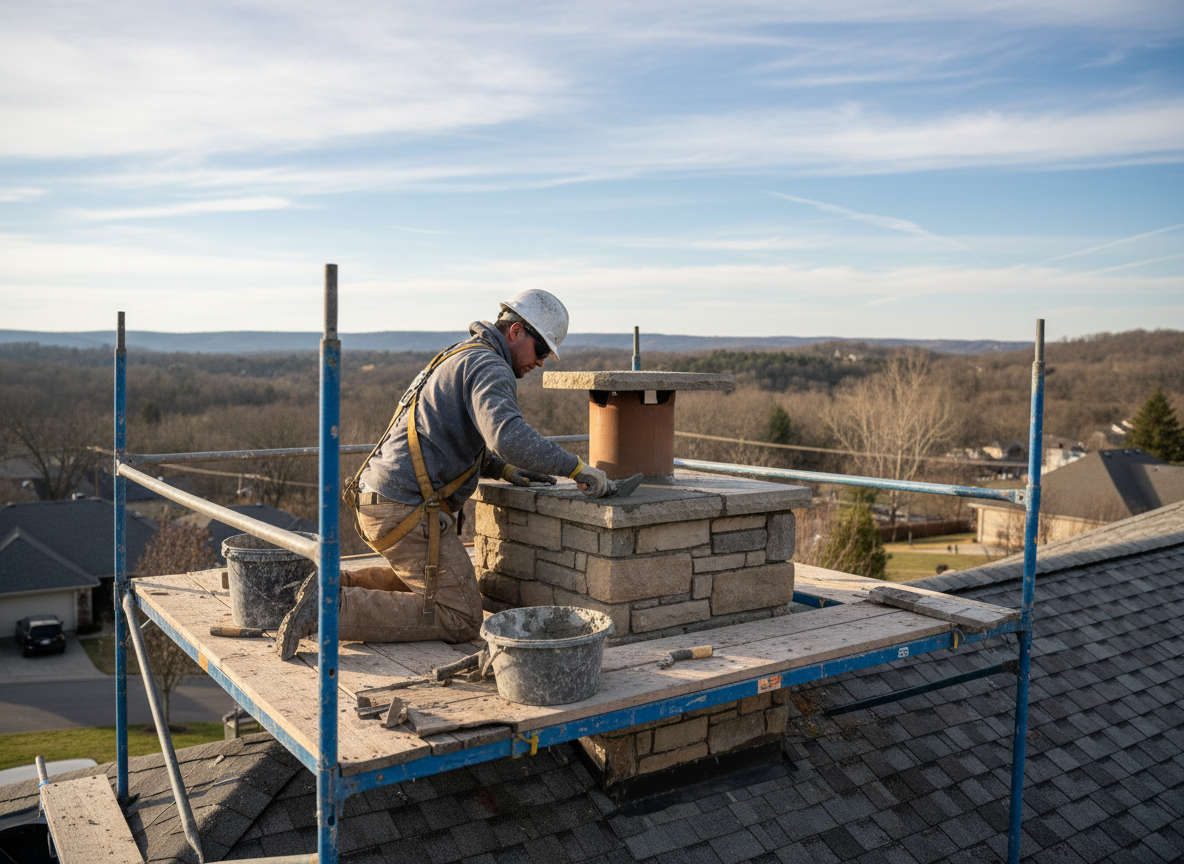
Chimney crowns in Oakley sit exposed to repeated freeze-thaw cycles that open hairline cracks in the concrete cap. Once water enters those cracks it migrates down the flue, saturates the brick, and accelerates spalling on the interior. Homeowners in the 45209 zip often notice white efflorescence or damp patches on the firebox after heavy spring rains. A proper repair starts with removing loose material, installing a new cap with a slight pitch and drip edge, and sealing the joint where the crown meets the flue tile with refractory mortar rated for direct flame contact.
Many pre-1950 homes in Oakley still use single-wall tile liners that were never designed to handle modern high-efficiency furnace exhaust. When the crown fails, acidic condensate pools at the base and eats through the clay tiles. We inspect the full height of the flue with a camera before any crown work begins because a new crown alone will not stop further deterioration if the liner is already compromised. In these cases we discuss options such as stainless-steel relining rather than simply patching the crown and walking away.
Cincinnati building code requires that any crown reconstruction maintain a minimum two-inch overhang beyond the chimney walls and that the new concrete reach 3,000 psi compressive strength. We form the pour on site with a welded wire mesh reinforcement and allow a full 72-hour cure before exposing it to weather. Skipping the cure time is the most common shortcut that leads to rapid cracking the following winter. Every job ends with a written report noting flue condition, crown dimensions, and any adjacent roof flashing that needs attention to keep water away from the masonry.
Technician insight
In Oakley the thing that catches most people out with chimney crown repair is how fast Ohio freeze-thaw cycles open cracks on the older brick stacks that sit on two-story homes with steep slate roofs; once water gets behind the crown it travels down the flue and you end up replacing tile instead of just the cap.
Oakley Crown Failure After Winter
Water was staining the interior brick on a 1928 Oakley home. Camera inspection showed the crown had cracked along the flue joint and water had reached the clay tile. We removed the old cap, poured a new reinforced crown with proper overhang, and sealed the joint. No further staining occurred the following spring.
How it works
- 1
Site Inspection
We examine the crown, flue, and surrounding masonry from the roof and interior to identify active leaks and structural movement.
- 2
Material Removal
Loose concrete and deteriorated mortar are cut out to sound substrate so the new cap bonds properly.
- 3
Form and Pour
A reinforced concrete cap with drip edge and proper pitch is formed and poured on site.
- 4
Cure and Seal
The new crown cures for three days before we apply a breathable masonry sealer and verify water runoff.
Pricing
Pricing is quoted after on-site inspection because crown condition, access, and any required liner work vary widely.